Somewhere tonight, a mother is holding her sick child and praying for help!
More than half the people on this earth cannot get the healthcare they need to survive.
Close your eyes and picture it: your child is burning with fever, struggling to breathe, and the nearest hospital is a two-day walk away. There’s no car. No ambulance. No neighbor with a truck. So you do the only thing left to you — you hold your child close, and you wait, and you hope morning comes gently.
For 4.6 billion people on our planet, this isn’t a nightmare. It’s Tuesday.
This is reality for half the world – not an exaggeration.
The Numbers Behind the Heartbreak
These aren’t just statistics. Each one is a name, a face, a family that will never be whole again.
This is reality for half the world – not an exaggeration.
Every hour, more than 555 children take their last breath – over 13,300 a day — most from illnesses a simple vaccine, a clean birth, or a five-dollar course of medicine could have stopped.
Nearly two out of three people on earth will never have access to safe surgery if they need it. A burst appendix. A broken leg. A difficult delivery. Conditions we consider routine here can be a death sentence there.
Every two minutes, somewhere in the world, a mother dies bringing life into the world — leaving behind a newborn who will grow up without her, and other children who will grow up too fast.
Behind every one of these numbers is a family who loved someone, and lost them, simply because of where they were born.
Every gift, every volunteer, every prayer moves someone from “no hope” to “here.”
But Here Is the Part of the Story That Gives Us Hope
Almost all of this suffering is preventable.
The very same conditions that are quietly devastating families across the world’s poorest regions — malaria, obstructed labor, infected wounds, pneumonia — are conditions that skilled hands and basic medicine solve every single day in well-equipped hospitals.
The tragedy isn’t that we don’t know how to save these lives.
The tragedy is that the care simply isn’t there yet.
That’s the gap Christian Health Service Corps exists to close.
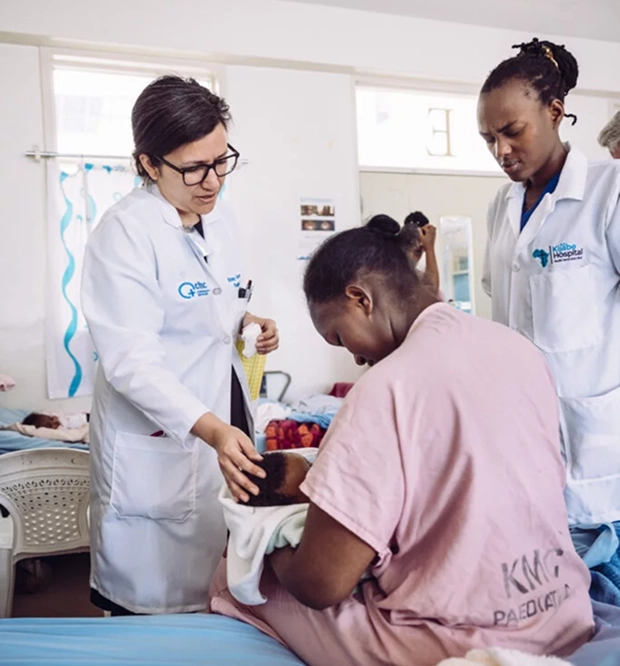
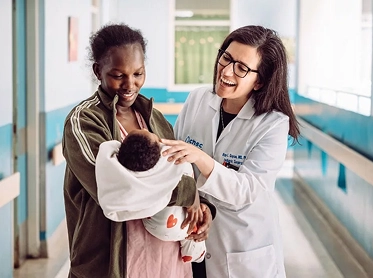
We walk alongside a growing family of mission hospitals across low- and middle-income countries, placing skilled, compassionate Christian doctors and health workers exactly where they’re needed most — so that a mother in labor has a trained hand to hold hers, so that a child with a fever has somewhere to go besides a prayer, so that a father doesn’t have to watch helplessly while something treatable takes his family from him.
Note on figures used above: child mortality is 2024 UNICEF data (13,300 deaths/day ≈ 555/hour, source #1); maternal mortality is the 2023 WHO estimate of one death every two minutes (source #5); “more than half” / 4.6 billion reflects the 2025 WHO/World Bank UHC Global Monitoring Report using 2023 data (source #12), replacing the older “half the world” 2017 figure. Since UN agencies publish new estimates most years, it’s worth re-checking these against sources #1, #5, and #12 before each future refresh of the page.
Sign-up and Claim Your FREE COPY
Contact a Recruiter
Preliminary Application for Missionary Service
This application is step one in making application to Christian Health Service Corps as a long-term medical or support staff missionary. If you are interested in serving for less than three years, please see the CHSC Reserve Corps Application.
Reserve Corps Application
Our Reserve Corps program allows healthcare professionals seeking to volunteer short-term to do so in a way that supports long-term Christian medical missions work. CHSC places healthcare professionals in a growing list of Christian hospitals across Africa, Asia, Latin America and other regions. Christian Health Service Corps works to improve access to primary healthcare, surgical services, and community-based disease prevention services. Non-Christian volunteers are accepted on a case by case basis but solely at the discretion of the hospital and CHSC team the volunteer will be supporting.